







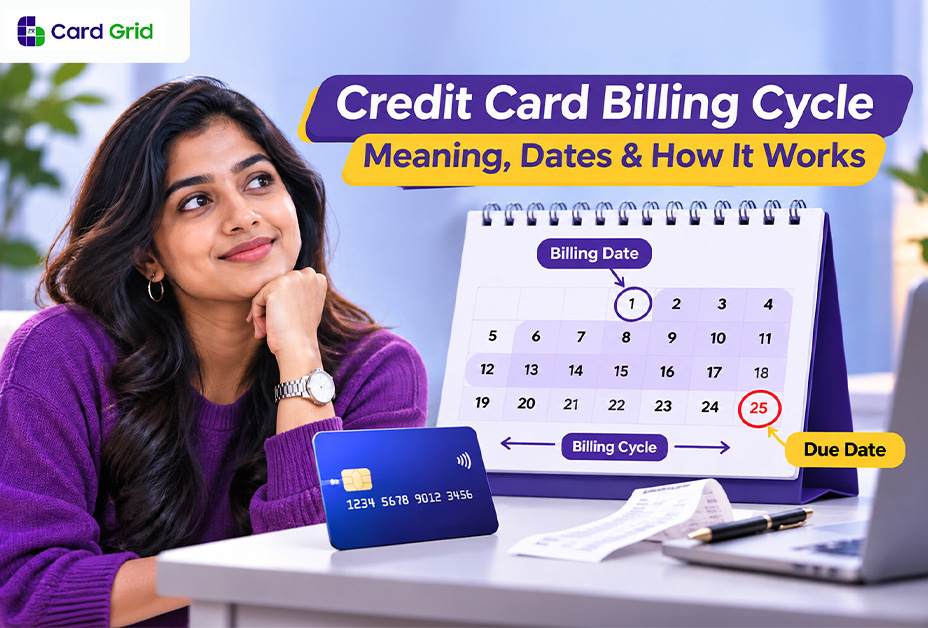

Have you ever wondered why your credit card bill arrives on a particular date every month, even when you make purchases on different days? The answer is your credit card billing cycle. Understanding your credit card billing cycle helps you track monthly expenses, plan repayments, avoid late payment charges and make better use of your credit limit.
Whether you use an Axis Bank, HDFC Bank or Canara Bank credit card, knowing your billing date and payment due date is important for managing your finances.
In this guide, we explain what a credit card billing cycle is, how it works, how to find your billing date and what you should know about different banks in 2026.
What Is a Credit Card Billing Cycle?
A credit card billing cycle is a fixed period during which your credit card transactions are recorded and grouped into a monthly statement.
A typical billing cycle lasts around 30 days, although the exact dates and duration depend on your card issuer.
At the end of the billing period, your bank generates a credit card statement containing:
- Total purchases made during the cycle.
- Outstanding balance.
- Minimum amount due.
- Total amount due.
- Applicable interest and other charges.
- Payment due date.
Example: Suppose your credit card billing cycle runs from 5 October to 4 November. Transactions processed during this period are generally included in the statement generated around 4 November.
You then receive a payment due date by which you must pay your outstanding bill.
What Is a Credit Card Billing Cycle Date?
The credit card billing cycle date generally refers to the date on which your billing period closes and your monthly statement is generated.
For example:
| Particulars | Date |
|---|---|
| Billing cycle starts | 5 October |
| Billing cycle ends | 4 November |
| Statement generation date | 4 November |
| Payment due date | 24 November |
The actual dates may differ depending on your bank and credit card.
Also read: 10 Most Common Credit Card Mistakes & How to Avoid Them
What Is the Difference Between a Credit Card Billing Cycle and Due Date?
Many cardholders confuse the billing date with the payment due date. However, both have different purposes.
| Feature | Billing Date | Payment Due Date |
|---|---|---|
| Meaning | Date your statement is generated | Last date to pay your bill |
| Purpose | Summarises transactions | Ensures timely repayment |
| Frequency | Usually monthly | Usually monthly |
| Importance | Tracks expenses | Helps avoid late payment consequences |
Paying the total amount due by the payment due date generally helps you retain the interest-free period on eligible purchases, subject to your card’s terms and conditions.
How Does a Credit Card Billing Cycle Work Step by Step?
A credit card billing cycle works in four simple steps:
- You make purchases: Eligible transactions are recorded against your credit card.
- The billing period closes: Your bank calculates the transactions and outstanding balance for that period.
- Your statement is generated: The bank sends your monthly credit card statement.
- You repay the bill: You pay the total amount due by the payment due date.
Example of a Credit Card Billing Cycle
Suppose your billing cycle closes on the 10th of every month.
| Transaction | Date | Amount |
|---|---|---|
| Online shopping | 12 October | ₹3,000 |
| Grocery shopping | 20 October | ₹2,000 |
| Flight booking | 5 November | ₹5,000 |
| Statement generated | 10 November | ₹10,000 |
| Payment due date | 30 November | ₹10,000 |
In this example, purchases processed between 11 October and 10 November are included in the statement.
Purchases processed after the statement closing date generally appear in the next billing cycle.
How to Find Your Credit Card Billing Date?
If you are wondering how to know my credit card billing date, here are some simple ways to check it:
- Mobile banking app: Log in and open your credit card section to view your latest statement.
- Internet banking: Check your credit card account and statement details.
- Email statement: Open your latest credit card e-statement.
- SMS notifications: Check billing alerts sent by your bank.
- Customer care: Contact your bank to confirm your billing date.
If you are asking, “How do I know my credit card billing cycle date?”, your latest statement is generally the easiest place to start.
Credit Card Billing Cycle and Due Date Calculator
A credit card billing cycle and due date calculator can help you estimate when your next statement and payment deadline will arrive.
Consider this example:
- Previous statement date: 15 October
- Next statement date: 15 November
- Payment period: 20 days
- Estimated payment due date: 5 December
Formula:
Payment Due Date = Statement Date + Payment Period
Remember that the actual payment due date is determined by your card issuer. Always follow the date mentioned in your latest statement instead of relying only on an estimated calculator.
Bank-Wise Credit Card Billing Cycle in 2026
The billing cycle differs between banks and sometimes between individual credit card products.
1. Credit Card Billing Cycle for Axis Bank
Axis Bank offers different statement generation dates depending on the credit card.
To understand how to know my credit card billing cycle Axis Bank, check your latest statement through Axis Mobile Banking or Internet Banking.
Axis Bank lists different billing dates for eligible cards. For example, its published options for certain cards include the 1st, 12th, 13th, 15th, 20th, 22nd and 25th of the month. Some cards have fixed billing dates.
You can contact Axis Bank to check whether your card is eligible for a billing date change.
2. HDFC Credit Card Billing Cycle
The HDFC credit card billing cycle follows a predetermined monthly statement date.
You can check your billing date through HDFC Mobile Banking, NetBanking or your monthly e-statement.
If you want to change your billing cycle, contact HDFC Bank to understand the available process and applicable conditions.
3. Credit Card Billing Cycle Canara Bank
For the Canara Bank credit card billing cycle, the billing date depends on the card network.
According to Canara Bank’s published credit card policy:
- Visa cards: Billing date is generally the 20th of the month, with payment due on the 10th of the following month.
- Mastercard and RuPay cards: Billing date is generally the 18th, with payment due on the 8th of the following month.
Canara Bank also provides specified billing cycle modification options, subject to eligibility and applicable conditions.
Note: Always verify your current billing date and payment due date through your bank’s latest statement.
Tips to Manage Your Credit Card Billing Cycle
Here are some practical ways to manage your credit card billing cycle effectively:
- Pay your total outstanding amount before the due date.
- Set payment reminders to avoid missing deadlines.
- Track transactions regularly instead of waiting for your statement.
- Avoid paying only the minimum amount due.
- Understand your billing date before making large purchases.
- Choose a suitable billing cycle if your bank allows changes.
- Review your statement for unauthorised or incorrect transactions.
The Reserve Bank of India (RBI) requires card issuers to provide cardholders with an option to modify their billing cycle at least once.
FAQs
Q. What is a credit card billing cycle?
A credit card billing cycle is the period during which your credit card transactions are recorded before the bank generates your monthly statement.
Q. Is the credit card billing cycle always 30 days?
No. It generally covers around a month, but the exact duration depends on your bank and billing dates.
Q. Can I change my credit card billing cycle date?
Yes. RBI guidelines require card issuers to provide an option to modify the billing cycle at least once, subject to the applicable process.
Q. Does my payment due date change every month?
It generally follows your monthly statement schedule. However, always check the payment due date mentioned in your latest statement.
Q. What Happens If You Pay Only the Minimum Amount Due on Your Credit Card?
The remaining outstanding balance can attract interest and other applicable charges. You may also lose the interest-free period on new purchases. Paying the total amount due is generally advisable.
Conclusion
Understanding your credit card billing cycle helps you manage monthly expenses, plan repayments and avoid unnecessary interest charges.
Whether you use an Axis Bank, HDFC Bank or Canara Bank credit card, regularly checking your billing date and payment due date is essential for responsible credit card usage.
Before choosing your next credit card, compare its annual fees, rewards, cashback benefits, travel privileges and repayment features. Explore, compare and apply for suitable credit cards on CardGrid to find an option that matches your spending habits and financial needs.


Add Comment