







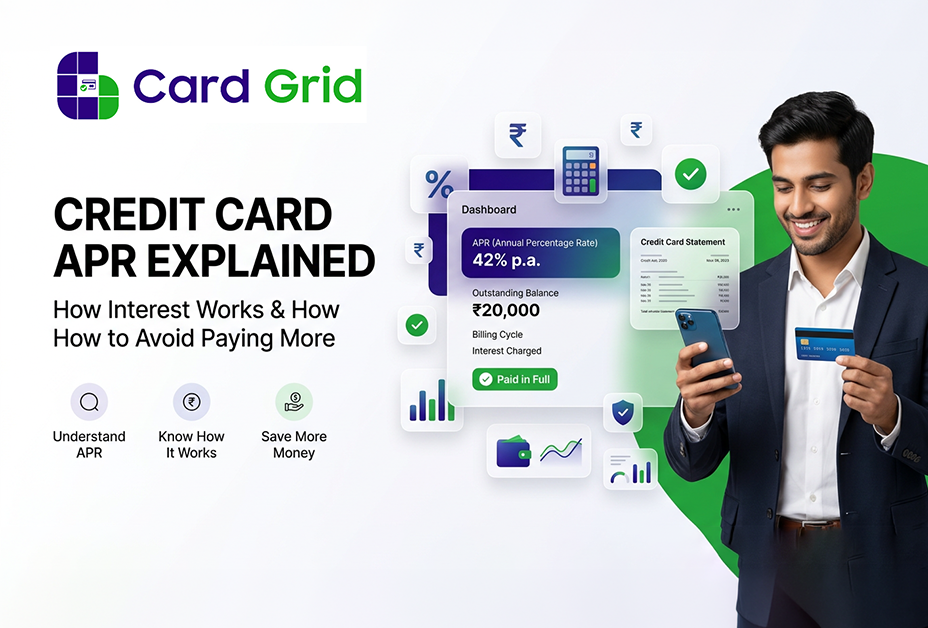

If you’re using a credit card, you’ve likely encountered the term Credit Card APR (Annual Percentage Rate) on your monthly statement or card agreement.Many cardholders ignore it because they pay their bills on time, but understanding APR is essential if you ever carry a balance or use certain credit card features.
Simply put, Credit Card APR is the annual rate of interest charged on outstanding balances when you don’t pay your entire credit card bill by the due date. Understanding Credit Card APR can help you save on interest charges and make smarter financial choices.
In this guide, we’ll explain everything about Credit Card APR, how it works, the different types of APR, how it differs from interest rates, and how you can avoid paying it.
What is Credit Card APR?
Credit Card APR (Annual Percentage Rate) is the yearly interest rate charged when you carry an unpaid balance on your credit card.
By paying your full statement balance before the due date, you can usually avoid paying interest on purchases. However, if you pay only the minimum amount due or carry forward your balance, the bank starts charging interest based on your card’s APR.
Example
Suppose:
- Outstanding Balance: ₹20,000
- APR: 42% per annum
If you don’t pay the full bill, interest begins accumulating daily until the outstanding amount is fully repaid.
What Does APR Include?
APR generally represents the annual interest charged on:
- Outstanding purchase balances
- Cash advances
- Balance transfers (if applicable)
- EMI conversions (depending on the card)
How Does Credit Card APR Work?
Credit card interest is usually calculated using the daily periodic rate.
Formula
Daily Interest Rate = APR ÷ 365
Then,
Interest = Outstanding Balance × Daily Rate × Number of Days
Example
Outstanding Balance: ₹50,000
APR: 36%
Daily Rate:
36% ÷ 365 = 0.0986% per day
If the balance remains unpaid for 30 days:
Interest ≈ ₹1,479
The longer the balance remains unpaid, the more interest accumulates.
Also Read: Latest HDFC Bank Credit Card Offers on Amazon 2026: Instant Discounts
Different Types of Credit Card APR
Not every transaction on your credit card carries the same APR.
1. Purchase APR
This applies when you carry forward unpaid purchases after the billing due date.
Example:
- Shopping
- Dining
- Online purchases
- Utility bill payments
2. Cash Advance APR
Using your credit card to withdraw cash attracts:
- Higher APR
- Cash withdrawal fee
- Interest starts immediately
There is usually no interest-free period for cash withdrawals.
3. Balance Transfer APR
Some banks allow transferring outstanding balances from another credit card.
These transfers may offer:
- Lower promotional APR
- Limited-time interest rates
- Processing fees
4. EMI APR
When purchases are converted into EMIs, banks may charge:
- Fixed interest
- Processing fee
- EMI-specific APR
Some merchants also offer No-Cost EMI options.
5. Penalty APR
Certain banks may apply a higher interest rate if you repeatedly:
- Miss payments
- Default on dues
- Violate card terms
Average Credit Card APR in India
Credit card APR varies depending on the bank and card type.
| Card Category | Typical APR Range |
|---|---|
| Entry-Level Cards | 30%–42% p.a. |
| Cashback Cards | 36%–45% p.a. |
| Rewards Cards | 36%–48% p.a. |
| Premium Cards | 30%–42% p.a. |
Always check your card’s Most Important Terms & Conditions (MITC) for the applicable interest rate.
APR vs Interest Rate
Many people confuse APR with the regular interest rate.
| APR | Interest Rate |
|---|---|
| Annualized cost of borrowing expressed as a yearly rate | The rate used to calculate finance charges on outstanding balances |
| Helps compare borrowing costs | Used by the issuer to calculate actual interest |
| Expressed annually | Often quoted monthly in India and annualized as APR |
For most Indian credit cards, the APR is derived from the monthly finance charge.
When Do You Pay Credit Card APR?
You generally pay APR when:
- You don’t pay the full outstanding amount.
- You pay only the minimum due.
- You withdraw cash using the card.
- You carry forward unpaid balances.
- Promotional offers expire.
When Do You Not Pay APR?
Normally, you won’t pay purchase APR if:
- You pay the full statement balance by the due date.
- You don’t use cash advances.
- You don’t carry forward unpaid balances.
This is known as the interest-free period, which can range from 20 to 50 days, depending on the billing cycle and purchase date.
How to Avoid Paying Credit Card APR
Following a few simple habits can help you avoid paying interest.
1. Always Pay the Full Bill
Paying the complete outstanding amount before the due date usually avoids purchase interest.
2. Avoid Paying Only the Minimum Due
Paying only the minimum due keeps your account active but allows interest to continue accumulating on the remaining balance.
3. Avoid Cash Withdrawals
Cash advances often attract:
- Immediate interest
- Higher APR
- Additional withdrawal charges
Use them only in genuine emergencies.
4. Enable Auto-Pay
Setting up automatic payments helps avoid missed due dates and late payment charges.
5. Keep Spending Within Your Budget
Only spend what you can comfortably repay each billing cycle.
Does APR Affect Your Credit Score?
APR itself does not directly affect your credit score.
However, consistently carrying high balances due to APR may indirectly impact your score because it can:
- Increase your credit utilization ratio
- Lead to missed payments
- Result in late payment fees
- Create repayment difficulties
Paying bills on time remains one of the most important factors for maintaining a healthy credit score.
Is a Lower APR Better?
Yes.
A lower APR means you’ll pay less interest if you ever carry a balance.
However, if you always pay your bill in full before the due date, the card’s rewards, cashback, annual fees, and benefits may be more important than its APR because purchase interest is generally not charged in that case.
Things to Check Before Choosing a Credit Card
Before applying for a credit card, choose a card that matches your spending habits rather than focusing on a single feature. Compare the following factors:
- APR (Annual Percentage Rate)
- Annual fee
- Joining fee
- Interest-free period
- Reward points
- Cashback benefits
- Fuel surcharge waiver
- Lounge access
- EMI options
- Late payment charges
- Foreign transaction fee
Important: Paying only the minimum amount due helps keep your account in good standing, but interest generally continues to accrue on the remaining balance. Repeatedly carrying balances can significantly increase your borrowing costs over time.
Final Thoughts
Understanding Credit Card APR is essential for using your credit card responsibly. While APR may seem like just another financial term, it directly affects how much borrowing can cost if you don’t repay your balance in full.
The simplest way to avoid unnecessary interest is to pay your full credit card bill on time, avoid cash advances whenever possible, and borrow only what you can comfortably repay. By following these habits, you can enjoy the convenience and rewards of your credit card while keeping borrowing costs under control.
Key Takeaways
- APR is the annualized interest rate charged on unpaid credit card balances.
- Paying your full statement balance by the due date usually avoids purchase interest.
- Cash withdrawals generally attract immediate interest and additional fees.
- A lower APR can reduce borrowing costs if you carry a balance.
- Paying on time and borrowing responsibly helps keep interest charges under control.
Frequently Asked Questions (FAQs)
Q. What is a good APR for a credit card?
The best credit card APR is the lowest one available. In India, most credit cards offer APRs between 30% and 48% per annum, though the exact rate depends on the bank and the specific card.
Q. Is APR charged every month?
APR is quoted annually, but interest is generally calculated on a daily basis and reflected in your monthly statement if applicable.
Q. Can I avoid paying APR?
Yes. In most cases, paying your full statement balance by the due date avoids purchase interest.
Q. Does paying the minimum due stop interest?
No. Paying only the minimum due avoids certain penalties, but interest usually continues to accrue on the remaining outstanding balance.
Q. Is APR the same for every transaction?
No. Purchases, cash advances, balance transfers, and EMI conversions may each have different applicable interest rates or charges.


Add Comment