






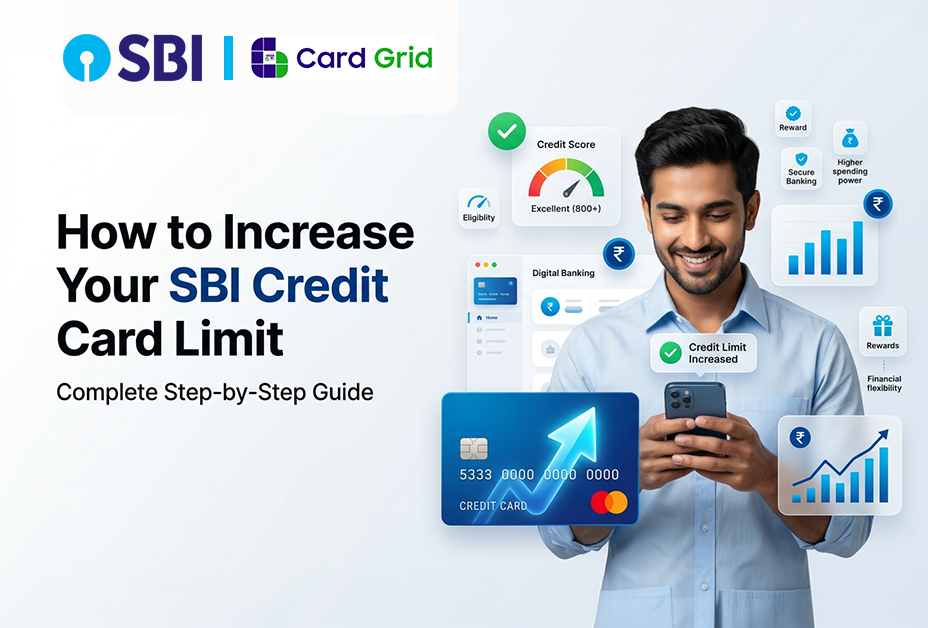

If you feel your SBI credit card increase limit request is overdue, you are not wrong to think so. As income and expenses continue to increase, the limit provided at the time of card issuance may not be sufficient. SBI allows eligible cardholders to raise their limit either through a formal request or by accepting a pre-approved offer from the bank. Before reading the methods given on this page, it helps to understand what SBI assesses during the review, how to check your current limit, and what mistakes not to do so the request doesn’t get rejected by the bank.
What Factors Are Taken Into Consideration By Your Bank?
SBI does not approve the SBI credit card limit increase request for every cardholder automatically. The bank reviews one’s financial profile and increases the limit only when certain conditions are met. Below are the key elements:
- CIBIL Score
A score of 750 or beyond is considered favourable. SBI checks this to determine your creditworthiness before offering an increased credit limit.
- Repayment History
Paying your bill in full and on time every month is one of the strongest factors in your favour. Missed payments or consistently paying only the minimum due reduce your chances of getting approval.
- Credit Utilization Ratio
Keeping usage under 30% of your existing limit ensures SBI that you are not overly dependent on credit. Consistently maxing out the card works against a limit increase request.
- Income
A stable or currently raised income improves your eligibility. If your salary has increased since the card was issued, updated income documents will support your request.
- Existing Liabilities
Active EMIs and outstanding loans on other products reduce the room for a limit increase, as your bank assesses your total repayment capacity.
- Relationship with SBI
Long-standing customers with a clear payment record are reviewed more favourably throughout the entire process.
How to Check SBI Credit Card Limit? (Effective Methods)
Before submitting a request regarding a credit limit increase, it is important to know where your current limit stands. Following is the answer to the question commonly asked by many of you, “How to check SBI Credit Card limit?”
1. SBI Card Mobile App
Download and log in to the SBI Card app. Your total credit limit and available limit will appear on the home screen under the Summary tab.
2. SBI Card Net Banking
Log in to your SBI Card online account and log in using your registered mobile no, user ID, or card details. Your credit and cash limit details will appear on the Account Summary page.
3. Chatbot ILA
Locate the ila.sbicard.com and log in using your user ID and password. Ask ILA for your available credit limit, cash limit, or outstanding balance right away.
4. SMS Banking
To use the SBI credit card limit increase SMS service for a balance check, send AVAIL <last 4 digits of card number> to 5676791 from your mobile number. You will get an instant SMS with your available credit and cash limit details.
5. Missed Call
Give a missed call to 9619898509 from your registered mobile number. SBI sends an SMS with your latest available limit within minutes.
6. Monthly Statement
Your SBI Card e-statement sent to your registered email address every billing cycle shows your total limit, available limit, and cash limit.
7. Customer care
Call 1860 180 1290 (toll-free) or 39 02 02 02 (prefix your local STD code). Follow the IVR, press 1 for credit card, and press 1 again to know about your available limit and account details.
8. SBI ATM
Insert your SBI Credit Card at the nearest SBI ATM, select Credit Card Account Balance, and type your PIN. Your available limit will display on the screen.
9. Visit SBI Branch
Head to your nearest SBI branch and provide your card details to the executive. They will provide you with current credit and cash limit details.
Also Read: Axis Bank Dining Offers August 2026: Save Big on Restaurants & Food Orders
How to Increase SBI Credit Card Limit? (Top 5 Ways)
There are five ways to get an SBI credit limit increase, with each method explained in detail:
1. Automatic Increase
SBI periodically reviews eligible cardholder accounts and increases the limit without any request. This usually happens when the bank identifies consistent on-time payments and responsible card usage over time. If you qualify, SBI notifies you via SMS or email. No action or documents needed.
2. Pre-Approved Offer
SBI offers limit increases to select cardholders based on their repayment behaviour and spending patterns. If eligible, you receive the offer via SMS, email, or as a pop-up on the SBI card app or website. Log in to the app or website, go to the Offers or Benefits section, and accept the offer directly. No documents needed, and the updated limit is generally active within 24 hours.
3. Request Via Net Banking or Mobile App
Log in to sbicard.com or the SBI Card app. Go to Services or Account Settings and choose the Credit Limit Enhancement option. Upload income documents and submit your request. Soft copies can also be emailed directly to SBI Card at the address given on their website.
4. Call Customer Care
To raise a request for an SBI credit card increase limit, give a call on 1860 180 1290 (toll-free) or 39 02 02 02 (prefix local STD code). Keep your current salary slip and bank statement handy because the representative may ask for these documents during the call.
5. Visit an SBI Branch
Go to your nearest SBI branch with physical copies of your income and documents. Branch staff will submit the request on your end.
List of documents:
- Latest 2–3 salary slips
- Last 3–6 months’ bank statements
- ITR or Form 16 for self-employed applicants
SBI generally processes formal requests within 7 and 10 working days. You’ll get an SMS and email confirmation once the new limit is activated.
What Not To Do?
- Wait at least six months between two requests. Frequent applications can lower your CIBIL score.
- Do submit accurate and updated income proof. Wrong documents are one of the common reasons for rejection.
- Pay down your outstanding balance before you apply. Submitting a request when you are already close to your current limit may reduce approval chances.
- Before applying for a limit increase, it is advisable to clear any pending dues. SBI is unlikely to approve an increase on a card with unpaid balances.
SBI doesn’t charge any fee for a standard limit increase request. Upon approval, keeping your usage below 30% of the new limit is what improves your CIBIL score steadily over time.
FAQs
Q. How can I increase my SBI credit card limit online?
You can increase your SBI credit card limit by accepting a pre-approved offer or submitting a request through the SBI Card app, SBI Card Net Banking, customer care, or by visiting the nearest SBI branch. If required, you’ll need to submit income documents for evaluation.
Q. What is the minimum CIBIL score required for an SBI credit card limit increase?
While SBI does not specify a minimum CIBIL score, a score of 750 or above is generally considered favourable. Along with a good credit score, timely repayments and low credit utilization improve your chances of approval.
Q. How long does SBI take to process a credit limit increase request?
SBI generally processes a credit limit enhancement request within 7 to 10 working days, provided all required documents are submitted correctly. You’ll receive an SMS and email once your request is approved.
Q. Can I increase my SBI credit card limit without submitting income proof?
Yes. If you receive a pre-approved credit limit enhancement offer from SBI, you can accept it without submitting income documents. However, manual requests usually require salary slips, bank statements, or ITR/Form 16 for evaluation.
Q. Why was my SBI credit card limit increase request rejected?
Your request may be rejected due to a low CIBIL score, missed or delayed payments, high credit utilization, insufficient income proof, existing loan obligations, or frequent credit limit enhancement requests. Maintaining a strong repayment history and responsible card usage improves approval chances.


Add Comment